
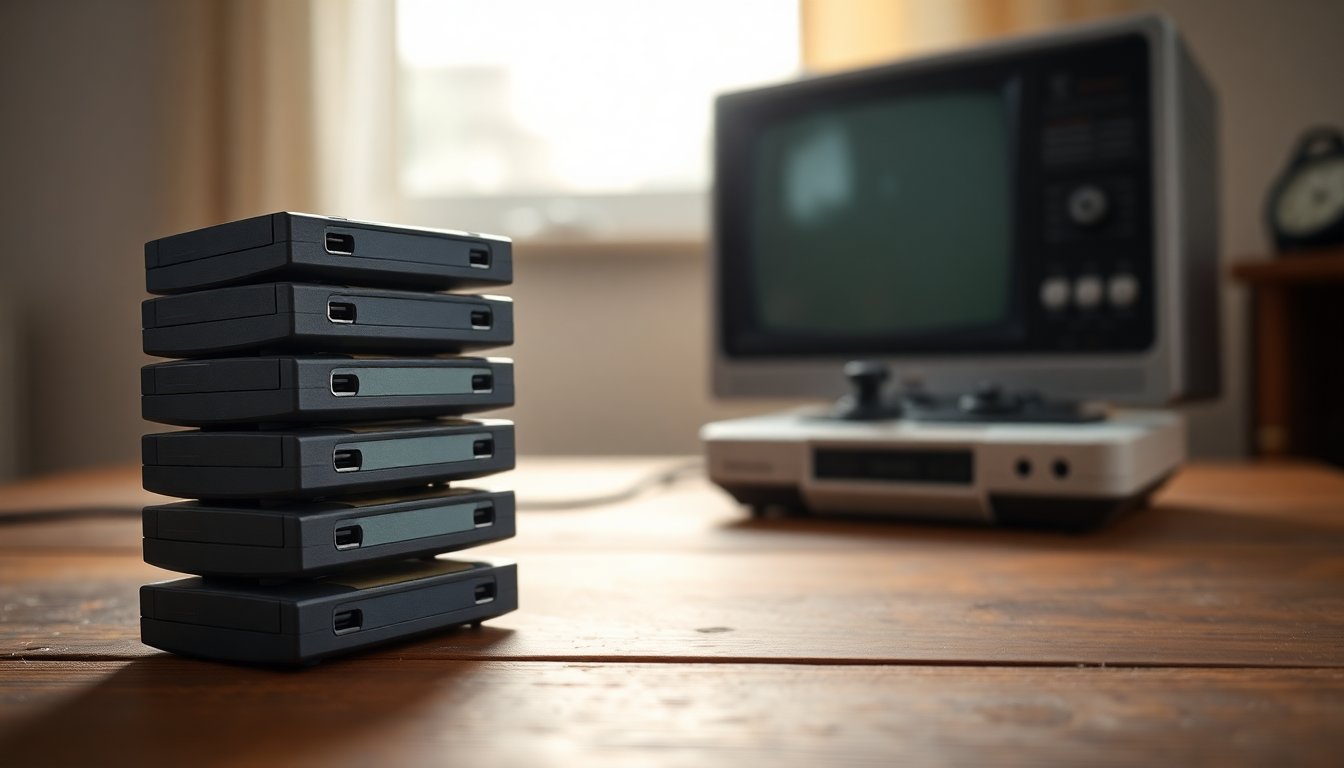
The home consoles originally released as the Family Computer in Japan and later as the Nintendo Entertainment System (NES) overseas built one of the most extensive libraries in retro gaming. Their market life produced 1,370 officially licensed games, along with seven official multicarts and two championship cartridges; of these, 672 were released only in Japan, 187 only in North America and 19 only in PAL countries, while 521 titles reached a worldwide audience. This article examines how those numbers came to be and why cartridges and peripheral formats mattered to developers, players and collectors.
Beyond raw counts, the platforms’ early software strategies influenced the industry. The Famicom shipped with first-party titles like Donkey Kong, Donkey Kong Jr. and Popeye at launch, while the NES launch lineup in North America included a broad mix of arcade conversions and new IPs: 10-Yard Fight, Baseball, Clu Clu Land, Duck Hunt, Excitebike, Golf, Gyromite, Hogan’s Alley, Ice Climber, Kung Fu, Pinball, Soccer, Stack-Up, Super Mario Bros., Tennis, Wild Gunman and Wrecking Crew. The final licensed title released for the family of systems was the PAL-exclusive The Lion King on May 25, 1995.
How licensing and third-party support built the library
Nintendo initially launched the Famicom with internal releases and quickly rolled out a formal licensing program that allowed third-party companies such as Namco, Hudson Soft, Taito, Konami, Bandai and Capcom to create and publish titles. Under the later scheme Nintendo required itself to manufacture cartridges for consistent quality control when the system shipped internationally, which centralized production and enforced royalties. This approach both expanded the catalog rapidly and created region-specific lineups, with many developers choosing to release some games only in Japan or only overseas. The licensing system also triggered legal and business tensions — including attempts by some publishers to avoid fees, which led to unlicensed releases later in the console life.
Cartridge design and technical differences
Form factor and pinout changes
The original Japanese cartridges—commonly called cassettes in Japan—used a 60-pin edge connector, with two pins allocated for optional external sound chips. When Nintendo adapted the system for the North American market in 1985, the company redesigned the physical package to fit a front-loading slot modeled after videocassette recorders. The resulting NES Game Pak measured approximately 13.3 cm high by 12 cm wide and adopted a 72-pin connector: two pins reserved for the CIC lockout and ten pins tied to the console’s bottom expansion port. The audio pins were removed from the cartridge edge and relocated to the expansion connector, meaning games that relied on external audio hardware required adaptation or reworking of soundtracks for NES releases.
Memory, mappers and space
Cartridge capacities varied widely: storage ranged from as small as 16 KB up to 1 MB (8 megabits), with 128–384 KB (equivalent to 1 to 3 megabits) being the most common sizes used by many titles. The extra internal volume afforded by the larger NES housings rarely changed game code directly, but it enabled the inclusion of additional hardware on the PCB, such as mapper chips for bank switching and special co-processors. Early transitional copies sometimes reused a Famicom printed circuit board inside an adapter shell to convert to the NES pinout—examples include early shipments of titles like Gyromite that paired the original PCB with an adapter to meet new connector requirements.
Famicom Disk System and the later cartridge resurgence
In 1986, Nintendo introduced the Famicom Disk System (FDS) in Japan, a peripheral that used proprietary 2.8-inch floppy disks to reduce per-unit costs and expand storage options for developers. The FDS solved some cartridge limitations initially, but disk-based distribution brought its own constraints—durability issues, slower loading and a separate sales and rewritable media ecosystem. As cartridge technology progressed and capacities and mapper features improved, many developers reissued FDS titles on ROM cartridges. Over time the market shifted back toward cartridges and support for the FDS faded through the 1990s.
Today the Famicom and NES cartridge era is studied for both its cultural impact and its technical decisions. The interplay between physical media design, licensing rules and regional marketing created a hybrid ecosystem of official, region-exclusive and unlicensed releases. Collectors and historians continue to catalog variations—board revisions, special cartridges and rare regional versions—preserving a detailed record of how the Famicom and NES helped define modern console distribution.


