
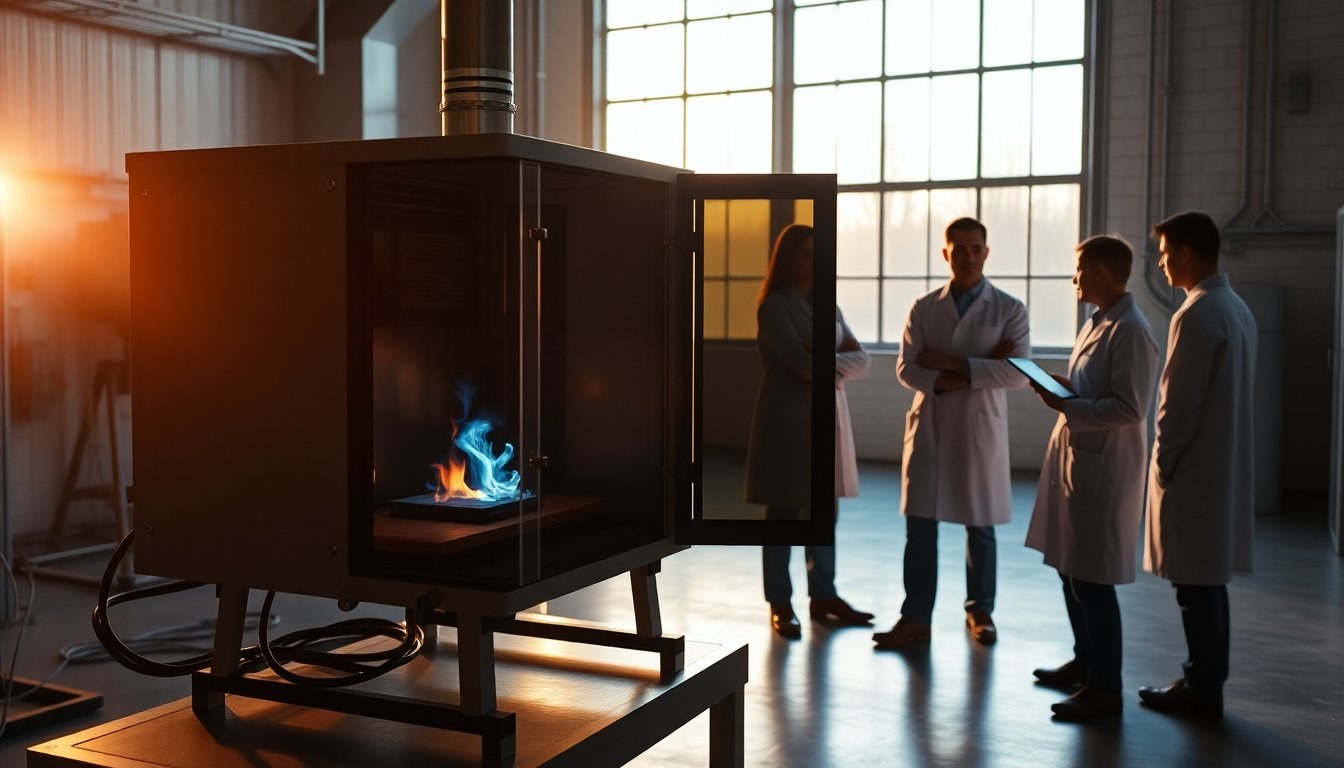
The U.S. Department of Energy Bioenergy Technologies Office (BETO) has committed $1.35 million in Phase 2 awards to support development of the next wave of residential wood heating technologies. These awards will be managed through the Wood Heater Innovation Collaboration (WHIC) and executed as part of the FY24 Wood Heater Cooperative Research and Development Agreement (CRADA). Administration and technical coordination are being provided by Brookhaven National Laboratory (BNL) and Lawrence Berkeley National Laboratory (LBNL), leveraging national lab expertise to accelerate validation, testing and commercialization.
This effort aims to reduce emissions and improve performance while keeping wood heating an affordable option for many households. According to the U.S. Energy Information Administration (EIA), millions of U.S. homes still rely on wood heaters for space heat, and wood remains an important low-carbon renewable fuel in those markets. The CRADA is intended to help manufacturers modernize stoves and introduce technologies that lower particulate emissions, boost efficiency and potentially cut household thermal energy costs.
Why this investment matters
Wood heating represents a mix of tradition and practical need in many regions, but older stoves can emit high levels of particulate matter and underperform on efficiency. By channeling resources into innovation, the program seeks to make wood heaters safer, cleaner and more cost-effective. The funding focuses on technologies that can be integrated into current products or retrofitted to existing units, creating pathways for rapid market impact. In doing so, the initiative hopes to reduce localized air quality impacts while maintaining the affordability and resilience benefits that wood heating offers to millions of households nationwide.
Selected projects
Three recipients were chosen to receive equal federal cost shares, each aimed at different technical approaches: catalytic solutions, control systems and add-on emissions devices. The awardees and their locations are Applied Ceramics (Laurens, South Carolina), ISB Marketing Inc. in conjunction with Stove Builder International (South Bend, Indiana), and MF Fire Inc. (Baltimore, Maryland). Each project receives a federal cost share of $450,000.00, combining to the announced $1.35 million. All projects will work closely with the designated national laboratories to test, validate and mature their concepts toward consumer-ready products.
Catalysts and add-on emissions solutions
Applied Ceramics, teaming with BNL, will design and test novel catalytic combustors aimed at lowering particulate matter produced by wood stoves. Catalytic combustors are engineered surfaces or materials that enhance post-combustion oxidation to reduce smoke and fine particles; in this program the technology will be evaluated for durability and efficiency across realistic operating cycles. Meanwhile, MF Fire Inc. will partner with LBNL to rigorously validate its Fire MAPS add-on technology, which initial consumer trials suggested can cut user-driven emissions when fitted to existing heaters. This validation will quantify real-world emissions reductions and support a broader consumer rollout if results are confirmed.
Control systems and product-ready designs
ISB Marketing Inc., working with Stove Builder International and LBNL, will pursue an autonomous, energy-efficient combustion control system designed to be affordable enough for widespread adoption. The team plans to simplify a previously developed high-end control architecture into a low-power, cost-effective solution that optimizes combustion across different phases of operation. The goal is a market-ready control package that improves emissions and performance without adding excessive cost to new or existing units, helping manufacturers offer better-performing wood heaters at consumer-friendly prices.
About WHIC and next steps
The Wood Heater Innovation Collaboration is a BETO-funded consortium of national laboratories—principally BNL and LBNL—created to speed development of cleaner residential wood heating technologies. WHIC’s role under the CRADA is to provide testing infrastructure, technical expertise and independent validation to help companies move concepts toward commercial readiness. Following testing and validation, successful technologies could proceed to larger consumer pilots, regulatory review where applicable, and scaled deployment to improve air quality and preserve affordable heating choices for households that depend on wood heat.


