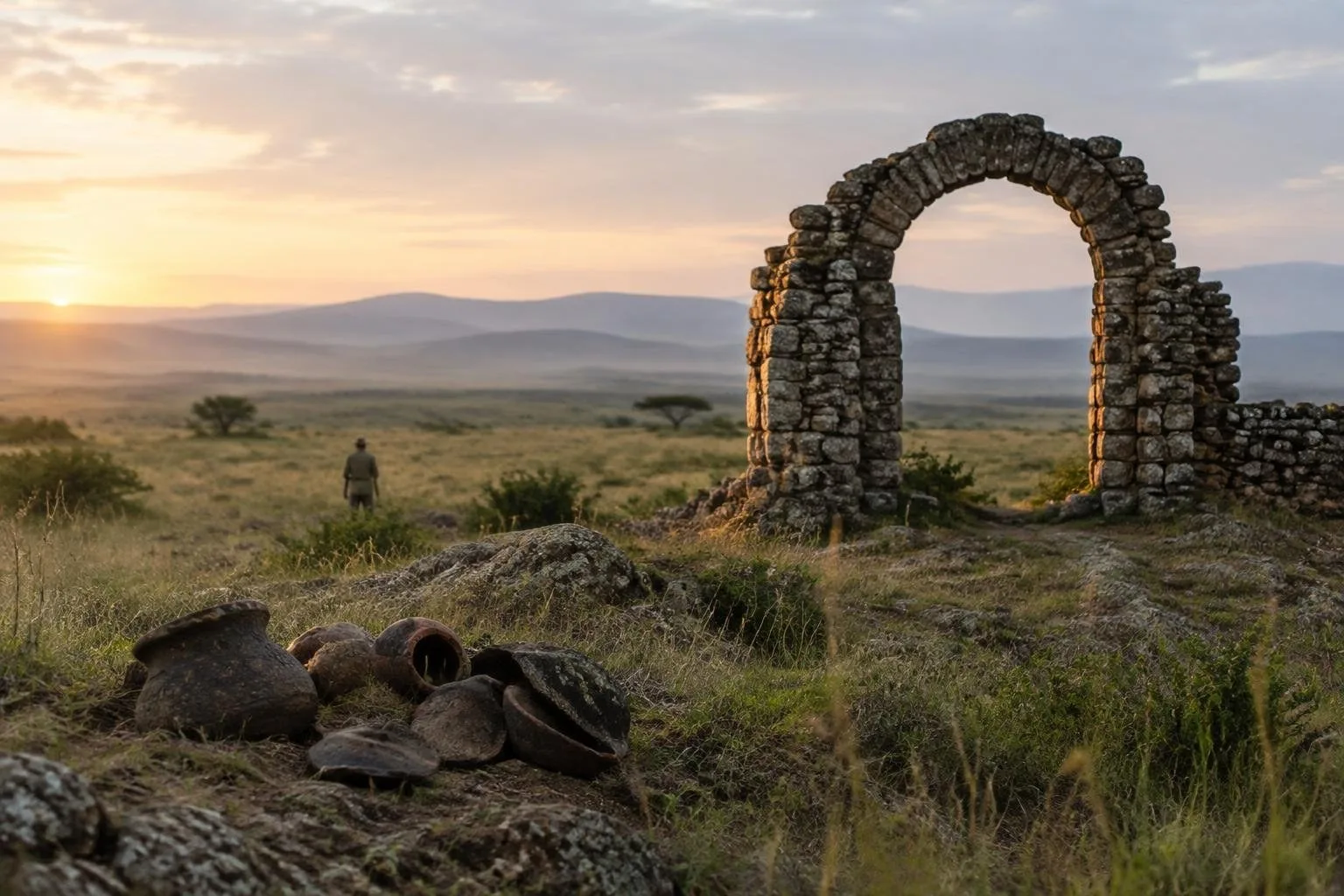
The story of how millions of people speaking related languages came to dominate sub-Saharan Africa has long been a puzzle. Sparse written records and limited funding meant that scholars relied on scattered clues: crumbling stone walls, shards of pottery, and oral traditions. In the past decade, a coalition of archaeologists, linguists and population geneticists has begun to stitch those fragments together, producing a picture that is both intricate and surprisingly coherent. By marrying the heat of ancient iron smelting with the precision of modern genomic analysis, researchers are finally able to trace the routes taken by the first Bantu-speaking communities as they moved out of western Africa.
Iron technology at Great Zimbabwe
Near the iconic dry-stone walls of Great Zimbabwe, archaeologists uncovered clusters of massive natural-draft furnaces that once reached temperatures above 2,100°F. Some of these structures spanned an adult’s arm-length, with thick walls designed to retain intense heat without the need for bellows. As Ezekiel Mtetwa of the Field Museum of Natural History explains, “The number and size of these furnaces, together with the use of natural-draft technology, indicate intensive and technologically sophisticated iron production.” Fragments recovered at the nearby village of Mashava, only 25 miles to the northwest, still bear the faint fingerprints of workers who once smoothed the clay interiors.
These furnaces were not merely industrial curiosities; they supplied the metal tools—hoes, axes, arrowheads—that powered agricultural expansion and warfare alike. The efficiency of the design meant that a single furnace could operate continuously, turning raw ore into usable iron with far less human labor than earlier bellows-driven models. Such technological edge likely gave Bantu communities a decisive advantage when they entered new ecological zones, allowing them to clear forest, till soil and defend settlements.
Language clues and the West-African origin
Even before the iron furnaces were studied, scholars had sensed a linguistic thread linking distant peoples. When the Portuguese explorer Vasco da Gama rounded the Cape in 1497, a crew member who had lived among West-Central African groups reportedly conversed with coastal dwellers in the far-eastern reaches of the continent. This uncanny mutual intelligibility sparked the 19th-century classification of the language family as Bantu, derived from the plural of *muntu*—“human being” in many of those tongues. The concentration of the greatest linguistic diversity in Cameroon’s Grassfields region further suggested that the family originated there, as language diversity typically peaks at a source.
Archaeological surveys across eastern and southern Africa reinforce the linguistic model. Pottery styles that evolve gradually from simple incised bowls to more elaborate stamped designs appear in a north-to-south sequence, mirroring the spread of farming, livestock and metalworking. Shadreck Chirikure of the University of Oxford notes, “You can clearly see a north-to-south progression,” emphasizing how material culture tracks the same routes inferred from words.
Genomic maps confirm a single migration wave
Genetics finally put the linguistic and archaeological hints to the test. A landmark 2009 study examined the DNA of 2,432 Africans and found that Bantu-speaking populations from western, central and southern Africa share a level of genetic similarity far greater than their geographic separation would predict. A more recent 2024 analysis of 1,763 genomes amplified that pattern: the widest genetic diversity among Bantu speakers resides in western Africa, and diversity steadily diminishes the farther groups moved east or south. As co-author Carina Schlebusch explains, “This is a typical signature of a population expanding from one place to another.”
These genomic signatures also illuminate the timing of the split between eastern and southern streams. Samples from Angola were genetically closer to those from Mozambique than to any from Cameroon, indicating that the two branches likely diverged only after the migrants cleared the southern edge of the Congo rainforest roughly 2,500–3,500 years ago. The combined evidence paints a picture of a single, massive wave of people carrying a “Bantu package” of farming, pottery, livestock and ironworking across the continent.
Mixing with local peoples and lasting impact
Arrival did not mean wholesale replacement of earlier hunter-gatherer societies. Genetic surveys reveal that many central-African Bantu groups share about an eighth of their DNA with rainforest foragers, while southern Bantu speakers carry a similar proportion of Khoisan ancestry. The pattern of male-biased Bantu ancestry combined with female Khoisan mitochondrial lineages suggests historical unions where Bantu men partnered with local women—often reflected in the persistence of click consonants in languages like Zulu and Xhosa. Ananyo Choudhury of the University of Witwatersrand remarks, “Whenever there is a power difference… between two groups, it tends to melt down to this.”
Beyond genetics, material exchange flourished. At a rock shelter in Mozambique, archaeologist Décio Muianga uncovered thousands of stone tools alongside Bantu-style pottery, indicating that hunter-gatherers were acquiring ceramics from farming neighbours. Historical accounts even describe Bantu groups inviting San people to perform rain-making ceremonies, underscoring a blend of economic and spiritual interactions. By the 12th–16th centuries, Bantu-derived states such as Great Zimbabwe participated in Indian-Ocean trade, exporting gold, ivory and high-quality iron while importing Chinese porcelain and glass beads—testimony to a civilization that had turned a prehistoric migration into a lasting economic network.