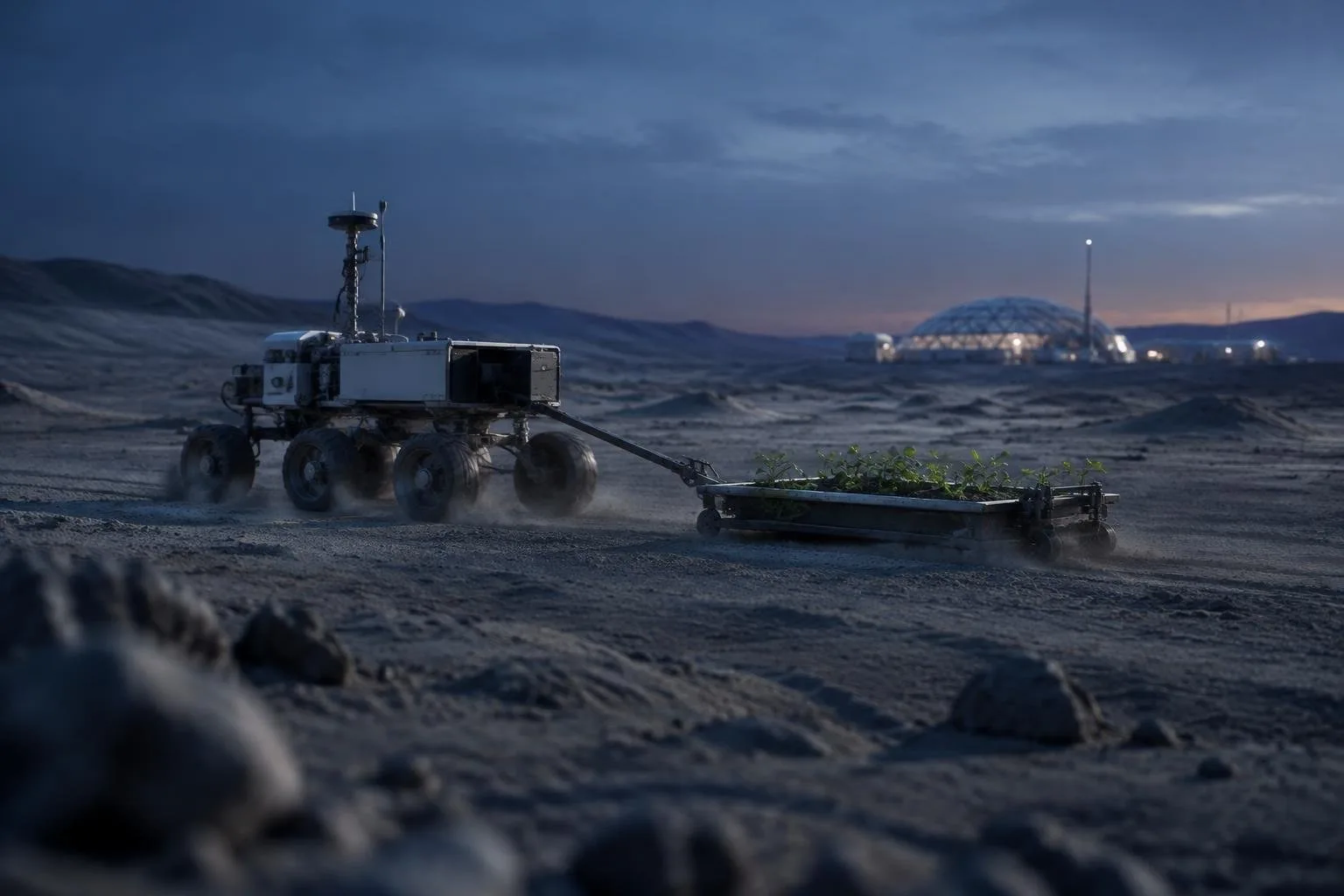
NASA’s ambition to establish a permanent human presence on the moon requires more than just habitats; it demands sustainable food sources. Transporting all necessary provisions from Earth is prohibitively expensive and logistically complex. Consequently, scientists are investigating whether crops can thrive in lunar regolith, the layer of loose rock and dust covering the moon’s surface. A recent study led by Oregon state university (OSU) offers a promising solution: supplementing simulated moon dust with organic matter allows potatoes to complete their entire life cycle safely.
Vermicompost Bridges the Toxicity Gap
The core challenge of growing plants in lunar regolith lies in its chemical composition. Unlike Earth soil, regolith lacks organic material and nitrogen, making it hostile to agriculture. It also contains elevated levels of heavy metals like copper, which can become toxic to plant roots. To overcome this, researchers used vermicompost, a nutrient-rich soil amendment produced when earthworms break down organic waste.
Aymeric Goyer, an associate professor at OSU’s Department of Botany and Plant Pathology, explained the mechanism behind this success. “We believe the compost helps balance some of the toxicity we see in lunar regolith by reducing plant exposure to harmful compounds,” said David Handy, a postdoctoral researcher in Goyer’s lab. The organic matter binds these heavy metals, preventing them from being overaccumulated by the plants. Without this supplementation, potato plants grown in pure regolith simulants were severely stunted with underdeveloped roots. However, mixing just 5% vermicompost with 95% regolith allowed for partial growth, while a 30% vermicompost mixture yielded results identical to those achieved in standard Earth soil.
Nutritional Safety and Yield Comparisons
The study, published in the journal npj Microgravity on Nov. 20, tested five different materials simulating regolith from both lunar mare and lunar highland regions. This variety ensures the findings apply across different potential base locations. The researchers specifically selected the Modoc potato variety, an early-maturing crop with red skin and white flesh. They chose potatoes because they provide more calories per land area than many other crops and offer substantial nutritional value, including potassium, vitamin C, and good proteins.
Crucially, the team verified that the harvested tubers were safe for consumption. Analysis showed no statistically significant increase in glycoalkaloids, naturally occurring toxins often associated with green discoloration. The nutritional quality remained intact despite the harsh growing medium. Although the researchers have not yet tasted the moon-grown potatoes, having used the harvest for lab analyses, the data suggests they would be as satisfying as their terrestrial counterparts.
Implications for Long-Term Space Exploration
This breakthrough supports NASA’s Artemis program, which aims for a sustained human presence on the moon. In the future, astronauts could bring a small amount of vermicompost to the moon and generate more by converting food scraps and plant waste into organic matter. This closed-loop system reduces the need to transport growing materials from Earth.
The benefits extend beyond space travel. David Handy noted that technologies developed for lunar agriculture could improve soil quality and remediate contaminated soils on Earth, particularly in regions reliant on shipments, such as inner cities and desert communities. While current experiments used small pots resulting in tiny tubers, a forthcoming paper will report on larger-scale tests using ten different potato varieties to identify the best candidates for future lunar farms.