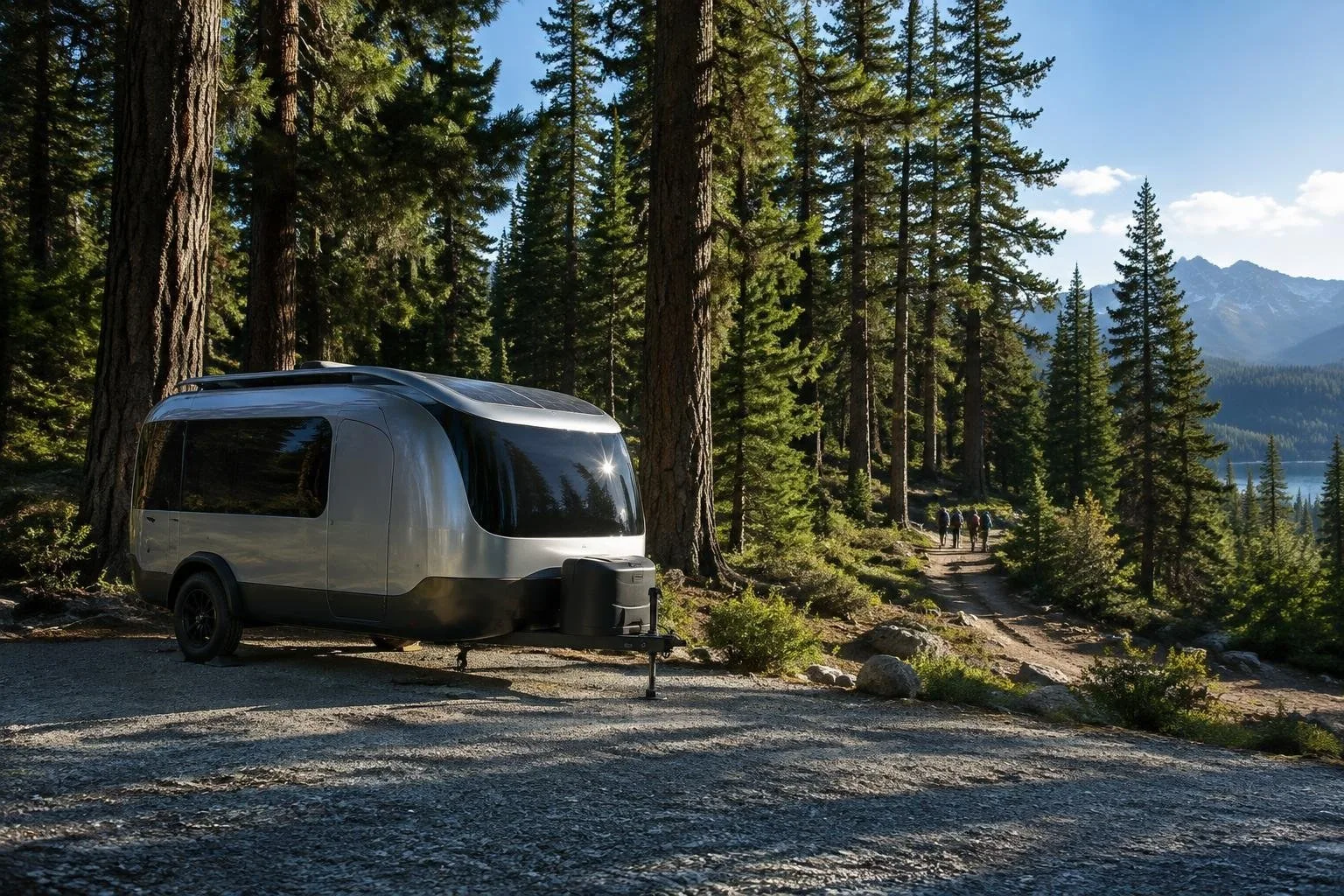
Outdoor gear often falls into two categories: rugged simplicity or fragile complexity. The Pebble Flow attempts to bridge that gap with a design philosophy that prioritizes ease of use over traditional mechanical reliance. For tech entrepreneurs like Ted Theocheung, who lives near the University of Oregon’s campus in Eugene, the appeal is immediate. His all-electric travel trailer resembles an elongated iMac, drawing stares at every campground.
Design Philosophy: NASA Meets Joshua Tree
Page Beermann, Pebble’s head of design and a former BMW designer, faced a specific challenge when creating the Flow. “Tech and cozy is not something I have a lot of experience marrying,” says Beermann. The team resolved this by asking, “What if NASA were designing a product for Joshua Tree? It’s our moon buggy.”
The result is a vehicle that feels distinctly futuristic. Missy Hartley, an owner based in Arizona who organizes retreats in Costa Rica, notes, “It feels like you live in a spaceship, and you come out and you’re like, ‘Where am I?’” However, this aesthetic comes with social implications. Theocheung warns, “If you’re an introvert, this isn’t the trailer for you.”
Battery Life and Power Capabilities
At the core of the Pebble Flow’s utility is a 45-kilowatt-hour battery. This capacity allows the trailer to function as more than just a living space; it acts as a mobile power station. Bingrui Yang, Pebble’s CEO, describes the unit as “a microgrid on wheels.” During a launch event at the Costanoa campground off Highway 1, Chef Ryan Davis powered an entire outdoor kitchen using only the trailer’s energy, eliminating the need for noisy generators.
For home users, the battery offers significant backup power during outages. When parked, the Flow can serve as a detached office or guest room. Recharging options include plug-in stations and optional rooftop or external solar units, enhancing its off-grid viability.
Self-Hitching Technology
Yang, a former Apple engineer with experience in autonomous systems at Zoox and Cruise, designed the Flow to solve the stress of traditional towing. “That freedom was just so hard,” he says. “Every second was just so stressful.” The solution is a self-propelling mechanism that aligns with a tow vehicle’s hitch ball via motor and camera control. Yang likens the process to “a spaceship docking on a space station.” A sales associate described the feature as “the marriage saver,” highlighting how it removes the physical coordination required for manual hitching.
Interior Layout and Practicality
The interior reflects Yang’s description of “Apple design meets Tesla tech.” An iPad controls lighting, heat, and window opacity. Appliances run on standard 110 volts, unlike the typical 12-volt system found in most trailers, allowing for household-grade refrigerators and microwaves.
Sleeping configurations vary. Two twin beds combine into a king-sized bed, while a dining booth transforms into a bed for two. Privacy is managed through a bathroom door that acts as a fixed partition. However, buyers should note the width constraints. Like many travel trailers, the Flow is narrow. Tall or large individuals may find the space snug, particularly when moving around the bathroom area.
Price and Market Position
The Pebble Flow models range from $159,000 to $189,000. While Seattle represents a top-five market due to its affluent outdoor culture, the cost places this item firmly in the luxury bracket. Stefan Solyom, Pebble’s chief technology officer, emphasizes that the behavior of the Pebble is defined by software, which shifts over time. This suggests ongoing updates similar to smartphone operating systems, potentially adding value but also requiring comfort with digital dependency.
If you are considering a purchase, weigh the convenience of self-hitching and massive battery storage against the premium price and limited interior width. For those seeking a definitive upgrade from traditional RVs, the 2027 model introduces further refinements, including a choice between a queen-sized Murphy bed setup or the twin-bed configuration, catering to different privacy needs.