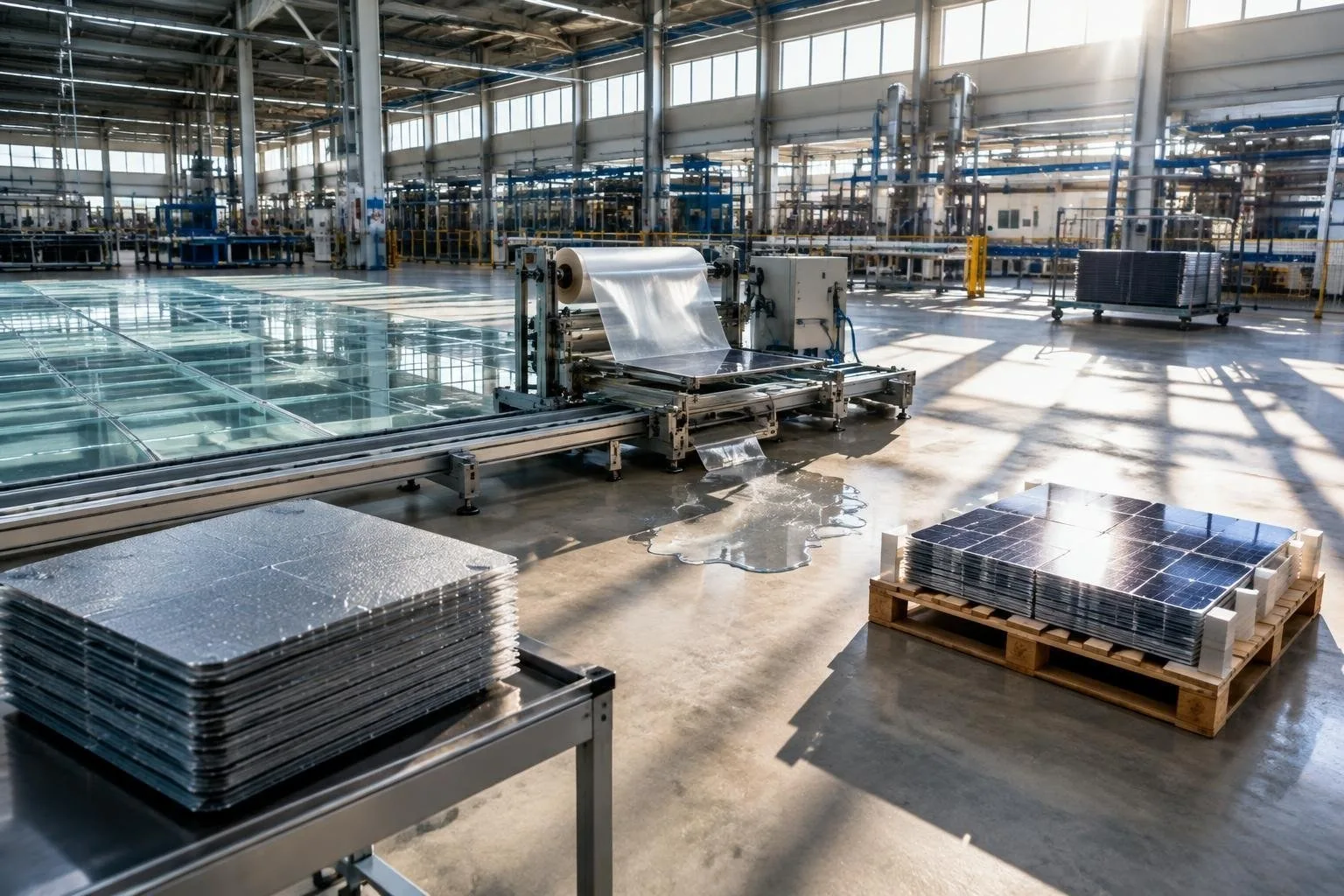
Crystalline silicon has ruled the photovoltaic (PV) market for decades, but its grip is not only a matter of conversion efficiency. A study from City, St George’s and the University of London shows that the real advantage lies in a mature manufacturing ecosystem: the network of factories, supply chains, and industry know-how that can scale cost-effectively. When investors, policy makers and equipment providers align their actions around a common production platform, a technology can move from laboratory to rooftop at pace.
Thin-film solar cells, despite offering attractive attributes such as flexibility and better performance under low-light conditions, never managed to break into the mainstream. The research points out that investment streams favored the uniqueness of each thin-film approach rather than shared tooling or process compatibility. As a result, the sector lacked the economies of scale that silicon enjoyed, and policy incentives were funnelled toward the already-established silicon supply chain. A different allocation of funds, one that rewarded reuse of existing manufacturing knowledge, could have given thin-film a foothold in emerging niches like building-integrated photovoltaics (BIPV).
Lessons for perovskites and tandem cells
The rise and stall of thin-film provide a blueprint for the next generation of PV technologies, especially perovskite and silicon-perovskite tandem cells. Early research often showcases record-breaking efficiencies in a single cell, but investors and regulators are increasingly looking for reproducible performance across multiple production lines. Demonstrating that a laboratory breakthrough can be duplicated at scale reduces uncertainty and attracts the long-term capital needed for factory construction.
Equally important is the balance between innovative device architecture and manufacturing standardisation. Companies that design perovskite modules to fit within existing silicon fabs, or that adopt deposition methods already familiar to the thin-film community, will likely accelerate commercialization. Over-emphasising proprietary processes may win short-term hype, but it limits the ability to tap into the global supply chain that propelled silicon to its dominant position.
Emerging technologies already leaving the lab
While the solar sector grapples with ecosystem effects, several unrelated deep-tech fields have crossed the laboratory threshold. Post-quantum encryption is now baked into mainstream software: Google Chrome switched to the ML-KEM key-exchange algorithm in late 2024, and Apple deployed the PQ3 protocol for iMessage with iOS 17.4. These algorithms are designed to stay secure even if future quantum computers can solve problems that break today’s elliptic-curve cryptography. NIST’s roadmap already schedules the retirement of RSA and ECC after 2030, signalling a rapid migration toward quantum-resistant standards.
Another breakthrough is satellite-based texting. T-Mobile’s T-Satellite service, built on SpaceX’s Starlink Direct-to-Cell network, lets recent smartphones send emergency SMS and limited app data without any ground-based tower. Since late 2025 the feature works in most U.S. dead zones, and regulatory approval of spectrum purchases in 2026 has cemented the business case for global expansion. Though voice calls remain limited to specific apps, the technology already serves as a safety net for travelers and remote workers.
Autonomous ride-hailing has also moved from pilots to paid services. Waymo operates a fleet of driverless vehicles in 15 U.S. cities and plans a launch in Madrid by 2027, while Amazon’s Zoox earned a federal exemption to run steering-wheel-free robotaxis in early 2026. Reported safety metrics show an 82 % reduction in injury-level crashes compared with human drivers over 271 million miles, although the data stem from the companies themselves. The sector’s rapid growth demonstrates that, once regulatory and reliability hurdles are cleared, autonomous fleets can become a regular part of urban mobility.
Finally, 2026 marked the emergence of AI agents that act on behalf of users rather than merely answering queries. These agents integrate with calendars, email, and third-party services, automating routine tasks and reducing the need for manual prompting. Their evolution underscores a broader shift from experimental AI prototypes to production-grade tools that deliver measurable efficiency gains.
What the future holds
Silicon’s continued dominance teaches a simple rule: technology succeeds when the surrounding industrial ecosystem can grow with market demands. For perovskites, tandem cells and other next-gen PV solutions, the path forward lies in aligning device design with existing fab capabilities and proving repeatable performance. In parallel, the real-world rollout of post-quantum cryptography, satellite texting, driverless ride-hailing and autonomous AI agents illustrates how deep-tech breakthroughs can become everyday utilities once standards, regulations, and supply chains converge.
Stakeholders (governments, investors, and manufacturers) should therefore focus on policies that reward ecosystem compatibility, on standards that guarantee security and interoperability, and on data that validates safety and scalability. By doing so, the next wave of technologies can avoid the thin-film pitfall and join silicon in shaping the daily lives of consumers worldwide.