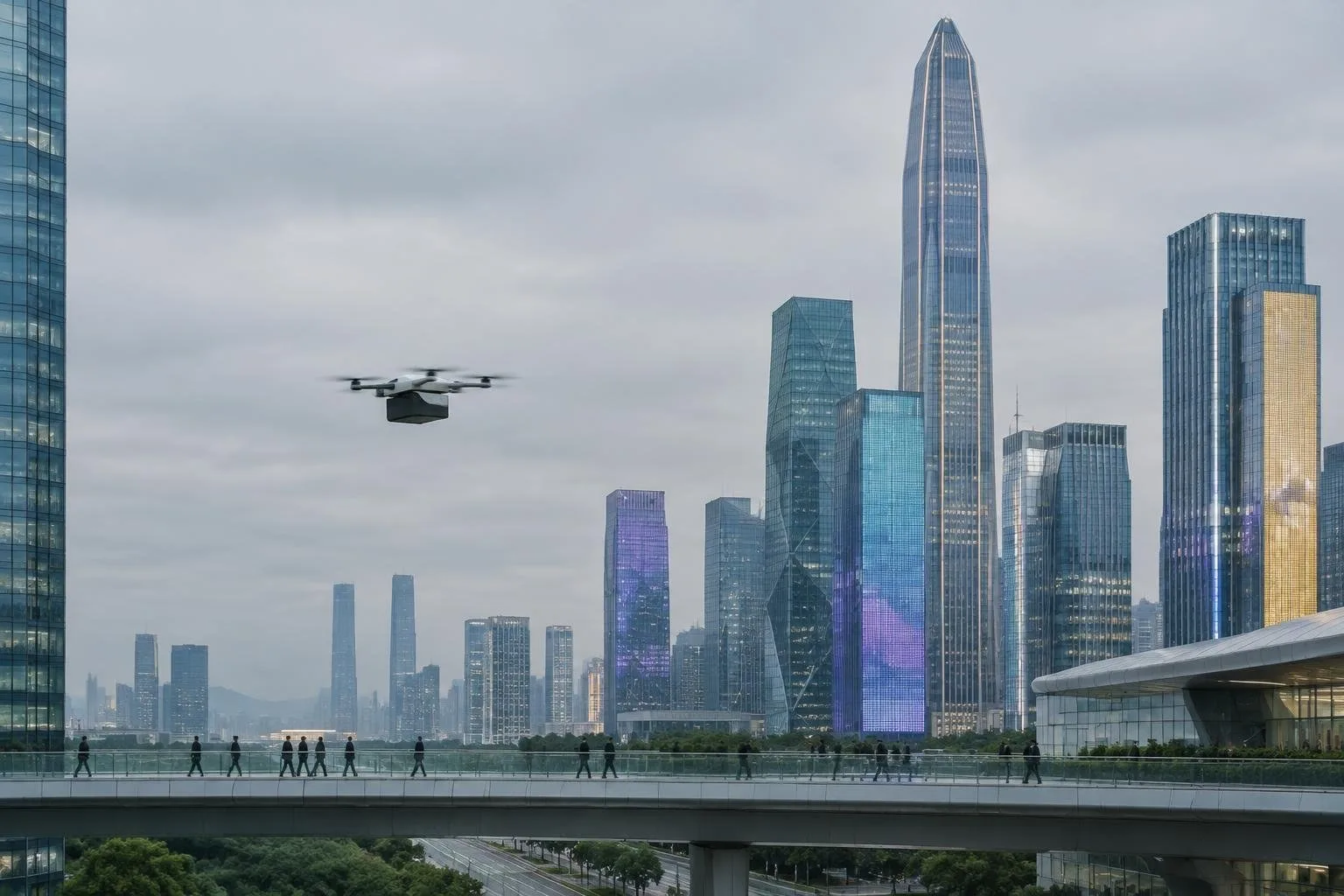
Under a canopy of shifting neon, the skyline of Shenzhen served as the visual metaphor for this year’s Asia-Pacific Economic Cooperation gathering. The city, once a tidal flat, now hosts a constellation of glass towers that flash cyan, violet, and the red and gold of the Chinese flag while repeatedly displaying “APEC 2026”. The spectacle was deliberately chosen to underline the host nation’s narrative: a nation that has turned a marshland into a global tech hub, and now wishes to project that story onto the world stage.
Shenzhen’s high-tech backdrop for APEC
Beyond the light show, the venue itself echoed the theme of digital progress. A humanoid robot handed out coffee at the media centre, and an exhibition traced Shenzhen’s evolution from a sparsely populated wetland to a “miracle in world development”, according to the display text. Professor Astrid Nordin of King’s College London described the city as a living showcase of Chinese technological and economic achievements, a visual argument that the nation can provide prosperity amid global uncertainty. The summit’s organization was reported as tightly controlled, with leaders required to stay at a state guesthouse next to a tiger-safari park, a setting designed to limit spontaneous dialogue while reinforcing a curated image of order.
Great-power dialogue: trade, AI and geopolitics
During the plenary, U.S. President Donald Trump and Chinese President Xi Jinping presented starkly different visions for the region’s digital future. Trump rejected “globalist regulation” of artificial intelligence, emphasizing a deregulatory stance and offering an Alaska LNG pipeline as a symbolic gesture of energy cooperation. In contrast, Xi outlined a four-pillar plan to build an “Asia-Pacific community” funded by $20 million for practical projects, a new Center for Asia-Pacific Community Studies, and coordinated mechanisms for cross-border data flows, clean energy and small-business development. The juxtaposition highlighted a growing asymmetry: Beijing proposes institutional architecture and financing, while Washington pushes a narrative of minimal regulation even as new export controls on advanced AI chips take effect across Southeast Asia.
Concrete outcomes and signals
Even amid rhetoric, tangible trade agreements emerged. Xi announced an extension of remission measures for Chinese steel and aluminium in exchange for reduced tariffs on Canadian pork, fish and seafood, a deal brokered with former Bank of Canada governor Mark Carney. A separate meeting with Papua New Guinea’s prime minister underscored Beijing’s geopolitical leverage, as the Pacific nation pledged to shut down Taiwan’s office despite domestic pushback. The anticipated trilateral summit with Trump and Russian President Vladimir Putin is likely to remain symbolic, offering China a platform to claim an equal seat at the global table without committing to substantive policy convergence.
China’s foreign ministry framed the gathering as a chance to achieve “practical results in trade, connectivity, digital economy, AI and so on”. The state news agency Xinhua echoed this, positioning the summit as proof that great-power competition need not be zero-sum. Meanwhile, the chair of the senior officials’ meeting, Chen Xu, highlighted “trade openness” as a core focus, hinting at further extensions of current agreements. Observers in the audience noted that the neon-lit backdrop reinforced a narrative of national pride: a local resident exclaimed that hosting the summit in Shenzhen made him feel “very proud”, linking the city’s export-driven rise to China’s broader geopolitical aspirations.
Overall, the APEC summit in Shenzhen merged spectacle with substance. The city’s rapid transformation provided a vivid illustration of the narrative China wishes to sell: a technologically vibrant, open-economy champion capable of shaping regional rules. At the same time, the divergent messages from Washington and Beijing revealed a widening chasm over how to govern AI, semiconductor supply chains, and digital trade. Whether the announced projects and tariff adjustments translate into lasting cooperation remains uncertain, but the neon-lit skyline ensured that the world left Shenzhen with a clear impression of China’s ambition to position itself at the forefront of the future digital economy.