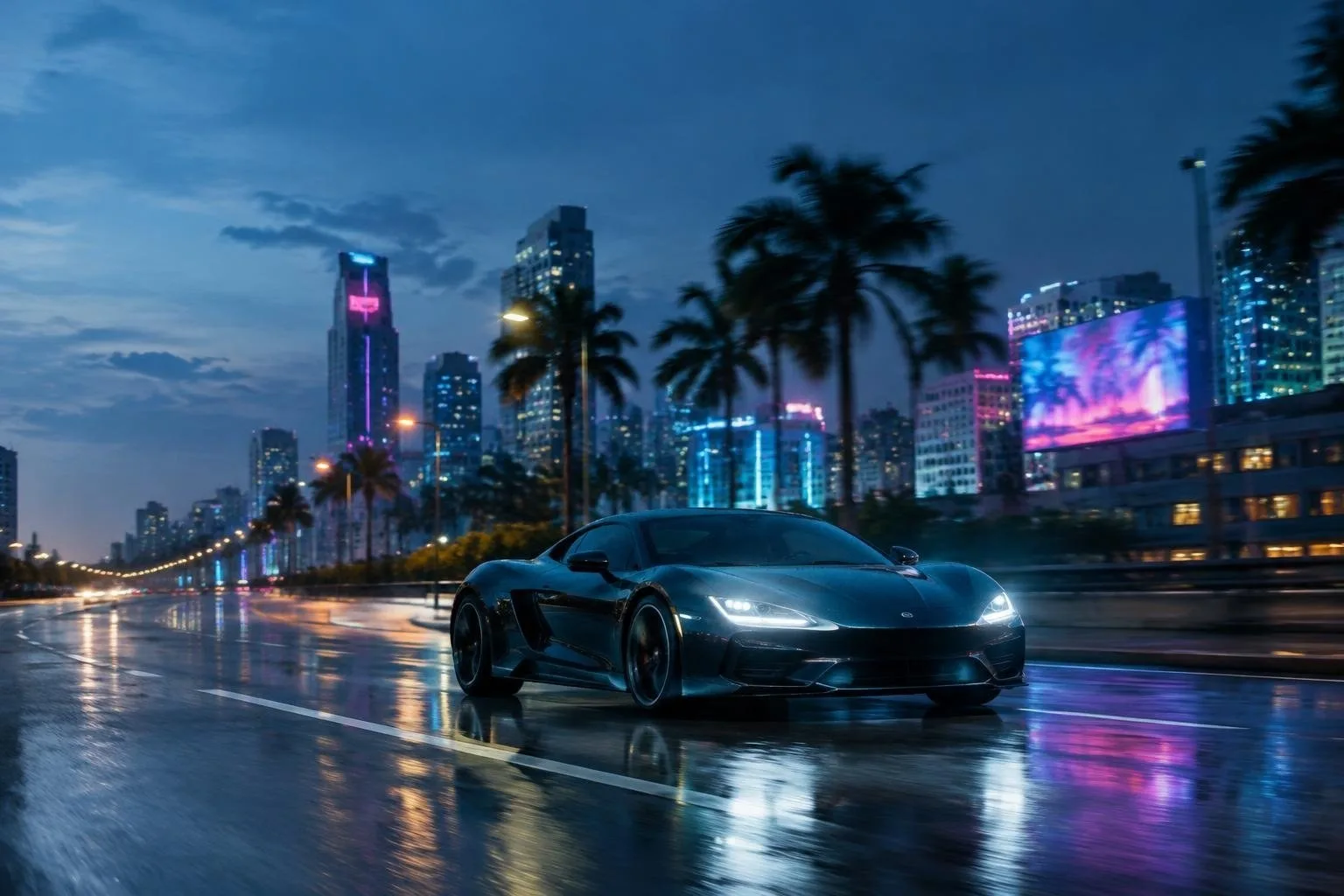
When Rockstar Games unleashed Grand Theft Auto VI on November 18, 2026, players rushed to Vice City with expectations of buttery-smooth motion. The marketing hype surrounding next-gen consoles suggested that the new PS5 Pro might finally deliver a true 60 fps experience. Early speculation was quickly dispelled by statements from Rockstar’s technology production director, Marc Chambers, who confirmed that “a 60 fps (or even 40 fps) mode won’t be coming to any launch console.” The decision rests on the game’s internal simulation workload, which taxes the CPU far more than the graphics processor.
Rockstar’s technical rationale for a 30 fps lock
Both the standard PS5 and the enhanced PS5 Pro render GTA VI at a base resolution of 1440p. The CPU in the Pro model is only marginally faster than the original console, and according to Chambers, “not powerful enough to run the game’s complex simulation at higher frame rates.” The open world of Vice City is densely populated with pedestrians, traffic, weather systems, and dynamic AI, all of which require constant calculation. Even if ray tracing were disabled, the CPU would remain at capacity, preventing any increase beyond the imposed 30 fps ceiling.
Visual upgrades on the PS5 Pro
The Pro’s GPU benefits from Sony’s latest AI-driven PSSR upscaling technology. While the base PS5 displays the game at native 1440p, the Pro pushes the image through upscaling to approximate a clean 4K picture, delivering sharper shadows and more defined reflections. Marc Chambers noted that the Pro adds “ray-traced shadows and sharper image clarity to the base game’s ray-traced reflections and lighting.” Digital Foundry’s measurements confirm that the Pro’s output appears “noticeably softer” on the standard console, whereas the Pro version approaches true 4K crispness. These enhancements improve visual fidelity without altering the frame-rate target.
Performance findings from Digital Foundry
Independent testing by Digital Foundry corroborates Rockstar’s claims. Both consoles maintain a locked 30 fps baseline, but the Pro demonstrates “perfect frame pacing,” meaning each frame is delivered at consistent intervals. The standard PS5, by contrast, occasionally slips into the “mid-20s” during prolonged explosion sequences, with occasional dips to 24 fps when the protagonist, Jason, “blows everything up on screen.” The Pro’s additional horsepower prevents these drops, offering a steadier experience even in high-action moments. Despite the lack of a higher frame-rate mode, Digital Foundry described GTA VI as a “landmark achievement in visual realism,” acknowledging the trade-off between fluidity and graphical depth.
Implications for players and future ports
For gamers who prioritize smooth motion, the 30 fps ceiling may feel restrictive, especially compared with titles that unlock 60 fps on similar hardware. However, those who value visual detail will find the PS5 Pro to be “the best platform for playing GTA VI,” as its AI upscaling delivers near-4K clarity while preserving the intended frame-rate stability. Rockstar has not announced a PC version yet, but historical patterns suggest a PC port could eventually lift the frame-rate limit, providing the missing high-refresh experience. In the meantime, players must choose between a softer image on the base PS5 or a sharper, more stable presentation on the Pro, with both versions sharing the same 30 fps cap.
The technological bottleneck lies within the CPU’s capacity to handle Vice City’s massive simulation load, not the GPU’s raw power. The PS5 Pro’s advantage lies in enhanced visual processing, not in breaking the 30 fps barrier. Until a PC release arrives, fans should temper expectations of a 60 fps mode and instead appreciate the image quality improvements that the Pro brings to Rockstar’s sprawling new sandbox.