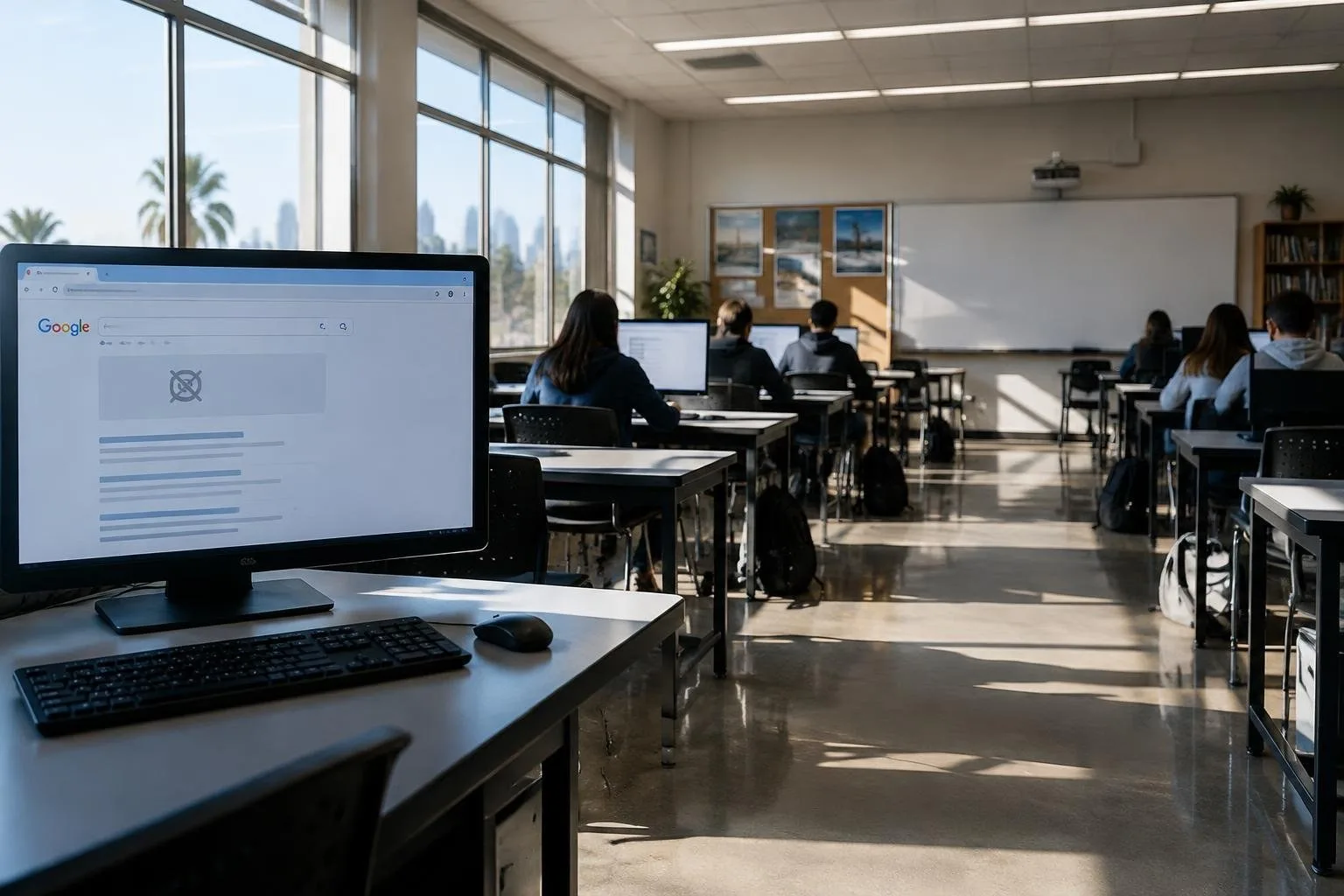
Los Angeles Unified, the second-largest school system in the U.S., has blocked most student access to the AI overview that appears in Google searches. The district did not make a formal announcement, and it has given limited detail about how the block was carried out. The move comes as Google has told schools it will not let them turn off the AI feature while keeping its search tool.
The dispute goes beyond one search feature. It raises a question about who controls the information that students reach, and about what happens to the open web when a single company bundles its models into the basic act of searching.
How the block works
According to the district’s statement, L.A. Unified temporarily suspended Google’s AI Overviews to keep students’ online experiences age-appropriate and safe. The block was applied through a filter provided by a company other than Google, whose name the district has not released. It covers the AI overview shown with a search, while a separate feature called AI mode had already been disabled on district computers given to students.
The district described the suspension as temporary. It also said that Google did not play a role in the recent changes, and that it continually evaluates its digital safeguards, including third-party tools.
Google’s position and the schools’ response
Google announced in early November that it would turn off Gemini and all search tools by default for K-12 schools in the coming months, with administrators required to switch each tool on. Chris Phillips, Google‘s vice president for education, told The New York Times that search and AI are deeply integrated. He warned that if schools ban AI, students will not have access to search.
Schools have reacted sharply. New York City Chancellor Kamar Samuels called the looming policy an ultimatum and said the city would look at other options. Los Angeles and New York both adopted one-year moratoriums on student use of generative AI in September, and a group of Google employees asked leadership to let schools turn off AI features without disrupting search as a whole.
Bridie Lee, a leader of Schools Beyond Screens, welcomed the block and described it as a win against Google’s ultimatum. Kelly Gonez, a member of the Los Angeles school board, said the timing of Google’s announcement looked like an effort to hold school districts hostage.
The technical and transparency questions
Heather Schwartz, director of education, employment and infrastructure at RAND, told the L.A. Unified board that there is too much evidence of cognitive offloading and eroded performance. Stephen J. Aguilar of the USC Rossier School of Education said there is no evidence that AI-enabled search is better, and that it can undermine the friction needed to teach digital literacy and critical thinking.
Google has said its AI products should support productive struggle, and it has pointed to its Guided Learning tool, which prompts students to work through concepts without going directly to the answer. A pilot in select U.S. schools was set to start later in the month, before expansion to other districts in the coming months.
Seen from the data side, the dispute centres on whether a district can filter the AI layer of a search engine without losing the search itself. Google has said it cannot separate the two. Whether a third-party filter can do so reliably, and at what cost to the rest of the results, is not addressed in the material available on the case, and the district has not disclosed how its filter works.