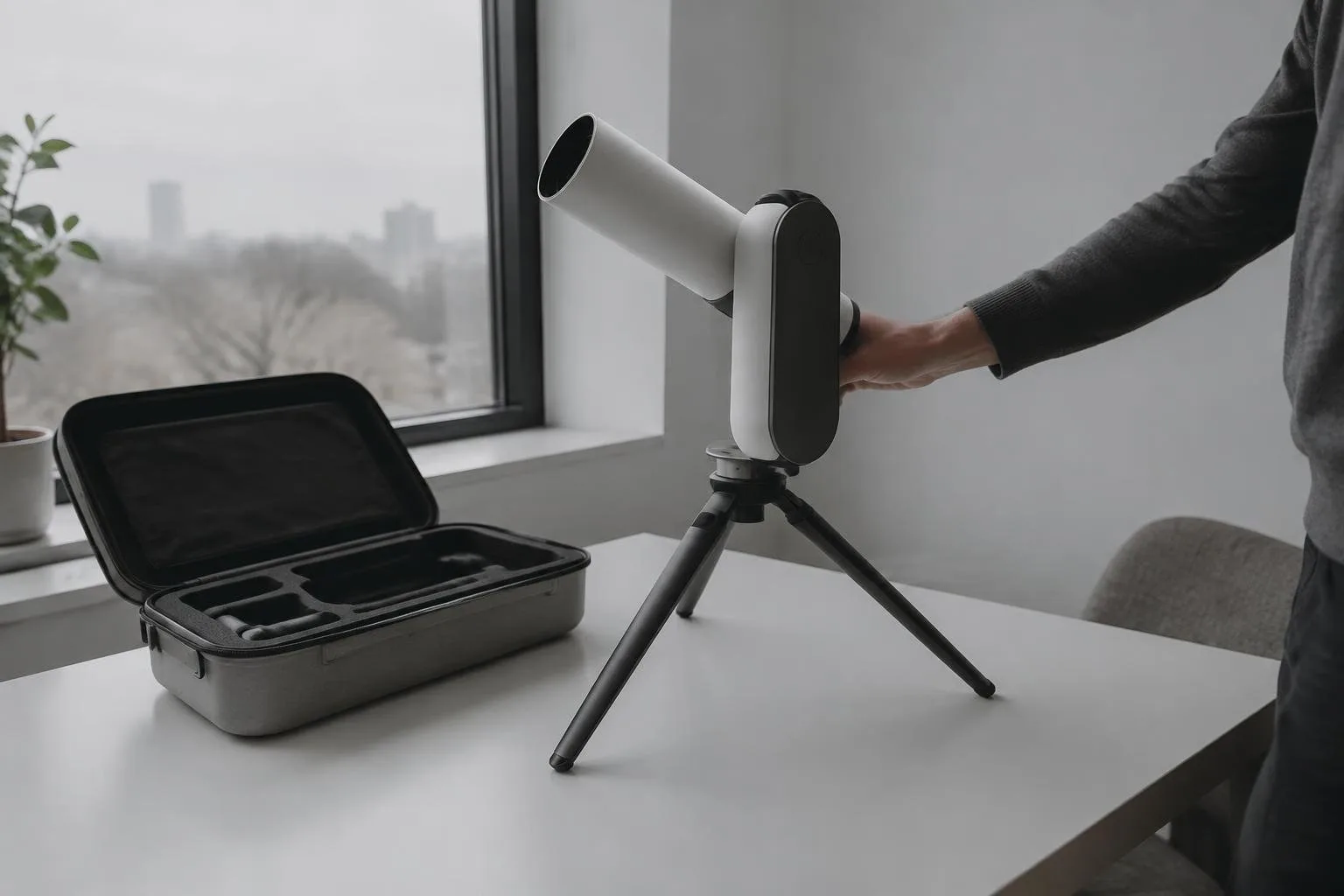
The Vaonis Vespera III arrives as a premium addition to the smart-telescope market, targeting users who want to capture deep-sky objects without assembling a traditional astrophotography rig. Priced at $2,490/£2,199, it sits well above entry-level alternatives, yet it promises an all-in-one solution: a 50 mm refractor, an 8.3 MP Sony IMX585 sensor, a motorised alt-azimuth mount, and a detachable tripod. The unit folds its optical arm into the body when powered down, creating a compact footprint that belies its 13 lb (6 kg) weight. First-time owners quickly notice the sturdy feel of the chassis and the low-profile design, though the price signals that the device is aimed at serious hobbyists rather than casual sky-watchers.
First impression and build quality
Optical design and sensor
Inside the Vespera III, Vaonis has retained the 50 mm refractor layout of its predecessor but upgraded the lens train to four elements in three groups, adding two extra-low-dispersion (ELD) elements to curb chromatic aberration. Coupled with the Sony IMX585 sensor, the telescope delivers sharp star points and a colour palette that rivals modest ground-based observatories. The sensor’s 8.3 MP resolution provides ample detail for nebulae and bright clusters, while the internal baffling reduces stray light—an especially useful feature for urban users battling sky-glow.
Battery life and tripod stability
According to Vaonis, the Vespera III can run for up to 11 hours on a single charge, and in practice the battery often lasts beyond a typical observing session. This endurance lets users focus on target acquisition rather than hunting for power packs. The supplied tripod is a noteworthy upgrade: tall, fully adjustable, and equipped with a fabric canopy that doubles as a storage pocket for accessories such as filters or a red sighting light. The overall stability is excellent, minimizing vibration during long exposures and contributing to the clean background seen in the final images.
Imaging capabilities
Multi-night stacking with PerseverENS
The standout software feature is PerseverENS, marketed as multi-night observation. The Singularity app can pause a session, return to the same target later, and automatically stack new exposures onto the existing dataset. This approach is a boon for faint nebulae that require hours of total integration time, especially in locations with unpredictable weather. The app even shows a live time-lapse of the stacking process, giving users a visual cue of how much signal is being accumulated.
Mosaic imaging with CovalENS
For objects that exceed the native 2.5 × 1.4-degree field of view, Vaonis offers CovalENS mosaic mode. The telescope captures adjacent sky sections and stitches them together, producing a larger composite image. While mosaics necessarily multiply the total exposure time (six tiles mean six times the duration), the result is a versatile way to photograph expansive clusters like the Pleiades or sprawling nebulae without moving the scope manually.
Software experience and accessories
Singularity app strengths and drawbacks
The companion Singularity app houses an extensive catalog of galaxies, nebulae, and star clusters. Users select a target, and the telescope slews, focuses, and begins imaging autonomously. However, the app lacks an interactive sky-chart; navigation relies on scrolling through lists rather than a visual star map. This can feel less intuitive compared with rivals that provide a real-time sky overlay. Additionally, the power-button indicator is subtle, occasionally requiring users to verify connectivity via their phone’s Wi-Fi list.
Filters and extra costs
While the Vespera III ships without built-in filters, a range of accessories can be purchased separately: a light-pollution filter (£219), a dual-band nebula filter (£399), and a solar filter (£179) for safe sun imaging. These add-ons substantially improve contrast and colour fidelity but also raise the overall investment. The ability to save raw, lossless TIFF files via the USB-C port gives advanced users the freedom to fine-tune images in external software, a flexibility not always present in competing smart telescopes.
Value proposition and Black Friday availability
When weighing performance against price, the Vespera III sits above many entry-level smart scopes such as the Seestar S50 Pro, which include built-in filters at a lower cost. For astronomers who already enjoy deep-sky imaging and are willing to invest in optional accessories, the Vespera III offers superior optics, longer battery life, and the convenience of multi-night stacking. Retailers typically list the telescope on platforms like Amazon, B&H Photo, and Unistellar, and the upcoming Black Friday event (Nov 27 – Nov 30) is expected to bring discounts of up to 20 % at those sites. Prospective buyers should monitor the listed stores early in the weekend, as inventory may deplete quickly.
The Vaonis Vespera III delivers a polished, colour-rich imaging experience that can rival modest dedicated setups, especially when users exploit its multi-night and mosaic capabilities. Its price tag limits it to dedicated hobbyists, but the combination of strong hardware and flexible software makes it a compelling candidate for anyone willing to spend a little extra for higher-quality night-sky photos.