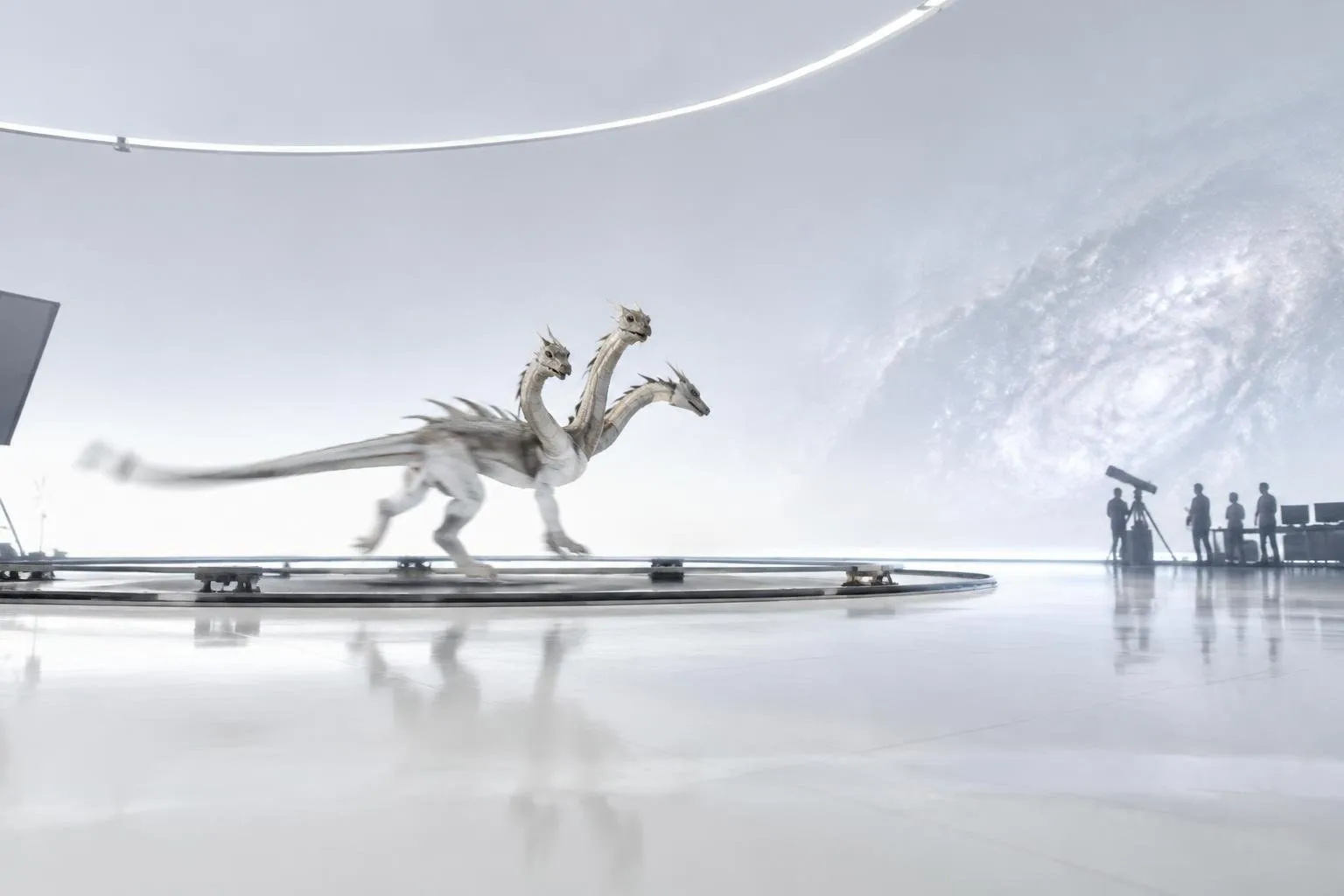
On Friday (Nov. 6) the latest Toho offering, Godzilla Minus Zero, opened in cinemas across the United States and the United Kingdom. The film pits the iconic lizard against his most persistent extra-terrestrial rival, the three-headed King Ghidorah. While audiences watch the kaiju clash on screen, scientists on Earth are simultaneously honoring the same creature by bestowing its name on one of the largest known structures in the cosmos.
The cinematic legacy of King Ghidorah
First introduced in the 1964 Toho production Ghidorah, the Three-Headed Monster, the golden, twin-tailed dragon arrived on Earth encased in a highly magnetic meteorite after a supposed rampage on Venus 5,000 years earlier. His second appearance, Invasion of Astro-Monster (1965), renamed him Monster Zero and revealed that the creature was being manipulated by the alien Xiliens from the distant Planet X. Over the next decade Ghidorah re-emerged in Destroy All Monsters (1968) and Godzilla vs. Gigan (1975), each time under the control of another extraterrestrial force. The character resurfaced in the Heisei era with a genetic origin in Godzilla vs. King Ghidorah (1991), served as a reluctant ally in the Millennium film Godzilla, Mothra & King Ghidorah: Giant Monsters All-Out Attack (2001), and returned to his cosmic roots in the Hollywood MonsterVerse entry Godzilla: King of the Monsters (2019). The new sequel, therefore, continues a four-decade arc that has seen Ghidorah evolve from a mind-controlled monster to a fully autonomous interstellar threat.
A real-world tribute: the King Ghidorah Supercluster
In late 2022, a team of Japanese astronomers using data from the Subaru Telescope identified a colossal aggregation of galaxies situated roughly 6.7 billion light-years from Earth. The structure spans an area equivalent to 19 full moons on the sky and stretches an astonishing 1.3 billion light-years across—large enough that the Milky Way could be placed inside it about 12,300 times. Consisting of at least 19 linked galaxy clusters, the formation was christened the King Ghidorah Supercluster in homage to Toho’s legendary antagonist. Its estimated mass equals 10,000,000,000,000,000 suns, making it roughly ten times heftier than the Laniakea Supercluster that houses our own Milky Way.
Why the name matters
The decision to label such an immense cosmic feature after a fictional monster underscores the cultural impact of the Godzilla franchise. By assigning a pop-culture nickname, astronomers make the abstract concept of a super-galactic structure more accessible to the public, bridging the gap between high-energy astrophysics and mainstream entertainment. It also reflects a growing tradition of naming astronomical discoveries after myths, legends, and even movies—a practice that both honors scientific achievement and sparks curiosity among non-specialists.
Connecting the fictional and the astronomical
While the on-screen battle between Godzilla and Ghidorah is a scripted spectacle, the real-world supercluster shares a genuine commonality with its namesake: both are colossal, formidable, and difficult to contend with. The King Ghidorah Supercluster is currently the largest known supercluster, dwarfing even the massive Laniakea. In the same way that Godzilla’s atomic breath and Ghidorah’s lightning-shaped attacks dominate the narrative battlefield, the combined gravitational pull of billions of galaxies governs the large-scale motion of the universe. Observers can watch the film and, later that evening, gaze at the night sky knowing that a structure the size of a small galaxy cluster bears the same moniker.
For fans eager to revisit the preceding entry, the Oscar-winning Godzilla Minus One remains available on Netflix, providing background for the ongoing saga. As the franchise continues to blend mythology, science fiction, and genuine scientific discovery, the synergy between Toho’s kaiju universe and modern astronomy promises to keep audiences and researchers alike looking up—both at the silver screen and at the stars.