
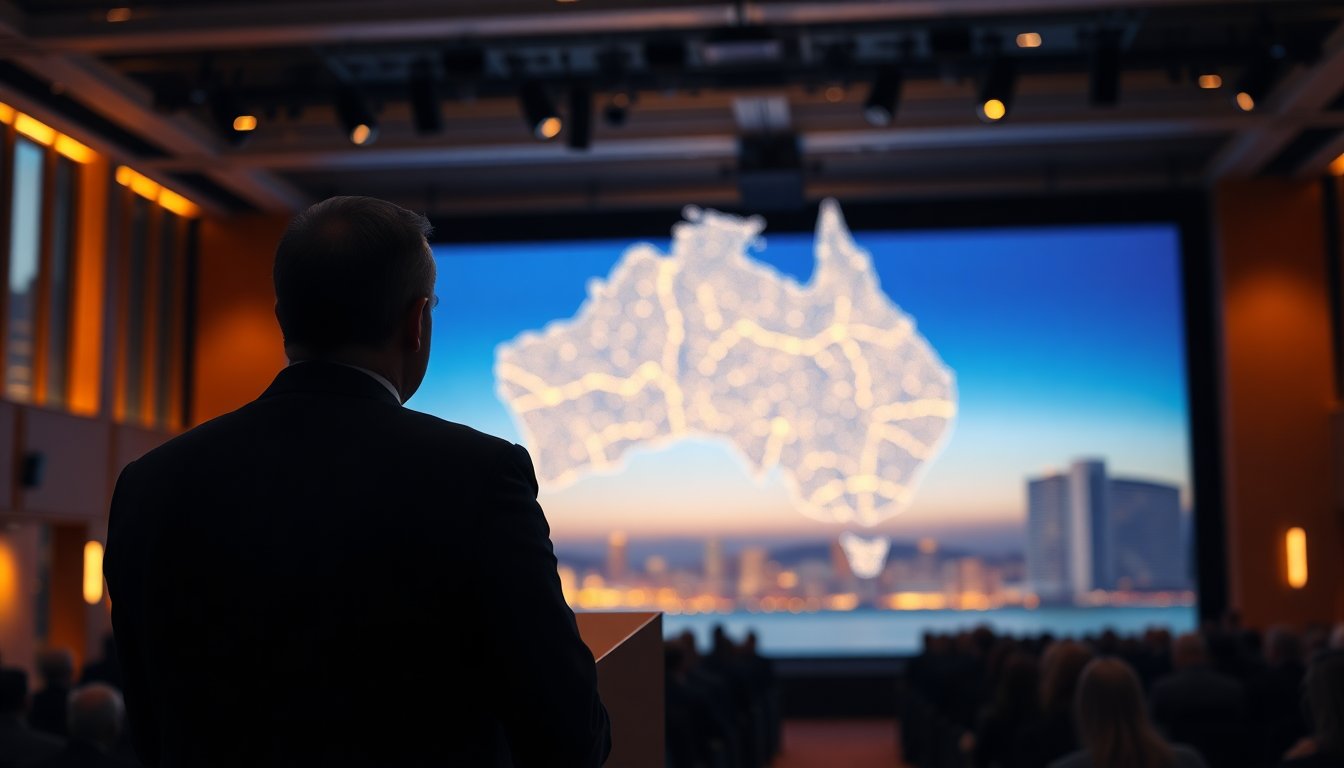
The technology landscape in Australia will be reshaped by a major corporate commitment announced on the Microsoft AI Tour in Sydney. Microsoft has revealed a planned investment of A$25 billion to expand local digital infrastructure and support programs across the country. Delivered by company leadership on stage in Sydney alongside Australian government representatives, the plan combines new cloud capacity, national security partnerships and large-scale upskilling initiatives to prepare the workforce for rapid change.
That investment is scheduled to be deployed by the end of 2029 and builds on earlier activity, including a prior A$5 billion commitment made in October 2026. The package aims to increase in-country AI supercomputing and GPU capacity, extend government-facing cyber protection, and provide training programs that reach millions of Australians. The announcement links technology expansion with public policy goals for secure, sustainable and locally beneficial infrastructure.
What the A$25 billion covers
The heart of the plan is a substantial growth of Microsofts’ in-country technical footprint. Investment will widen Azure AI and cloud offerings, deploy advanced processors and boost the local presence of AI/GPU resources so organisations can run demanding models without leaving Australian data regions. Microsoft expects to expand its footprint by more than 140 percent, increasing resilience and capacity for both public and private sector customers. These moves are framed inside a Memorandum of Understanding with the Australian Government that affirms adherence to the government’s expectations for datacentre and AI infrastructure developers, including environmental and sovereign considerations.
Infrastructure expansion and sustainability
Infrastructure work will not be limited to compute. Microsoft has signalled commitments around energy and water, linking growth to sustainability targets such as matching energy consumption with 100 percent renewable purchases and pursuing water-positive operations by 2030. The company also highlights local job creation, expanded support for startups and increased research collaboration as part of the broader economic impact. Independent analysis previously attributed significant local contribution to Microsoft’s operations, and this new investment aims to deepen that role across the digital economy.
Cybersecurity and national resilience
Security is a core pillar of the announcement. Microsoft will extend the existing Microsoft–ASD Cyber Shield partnership to cover additional federal agencies, building on a program that already secured thousands of accounts and identified previously unknown vulnerabilities. The expanded arrangement involves closer collaboration with the Australian Signals Directorate, the Department of Home Affairs and the Digital Transformation Agency to deliver improved configuration, threat visibility and integration with national threat-sharing systems. The goal is to strengthen national resilience against evolving cyber threats and to make protections available to smaller organisations and consumers.
Public-private cooperation
Microsoft and government agencies said the approach will be based on sustained collaboration rather than purely technological fixes. Priority areas include connectivity, hyperscale cloud resilience and coordinated threat intelligence. The announcement emphasises that national cyber resilience requires both engineering work and ongoing partnership to be effective at scale, especially as critical services move to modern cloud platforms.
Skills, schools and communities
On the workforce front, Microsoft committed to training three million Australians with workforce-ready AI skills by 2028, describing it as the largest program of its kind in the country. This builds on an earlier goal to deliver skills to one million people across Australia and New Zealand by the end of 2026, a target Microsoft says it met ahead of schedule. New education efforts include programs for teachers, free AI readiness credentials for nonprofit leaders, and partnerships to bring an AI-powered career coach to schools, aiming to deliver practical guidance to students at key decision points.
These skilling measures are paired with labour-focused engagement, such as a workers summit convened with union leadership to discuss practical, worker-centred AI adoption. Microsoft frames the portfolio as a combined investment in capability, security and social adoption: stronger compute, safer systems and a workforce equipped to use the technology responsibly.
Taken together, the announcements position Australia as a target for large-scale AI infrastructure investment while stressing governance, sustainability and inclusion. With commitments spanning hardware, policy collaboration and human capital, the A$25 billion pledge is designed to support long-term national objectives for technology-driven growth.


