Buying a new gaming platform in 2026 feels like a financial tightrope. The latest PlayStation 5 Pro sits at $1,250, while a decent PC build can quickly eclipse $1,000 when component prices are inflated. For gamers who want the best value, the question becomes: which NVIDIA GPU mimics the console experience without breaking the bank?
RTX 2070 Super as the closest match to the base PS5
The frame-counting team at Digital Foundry identified the RTX 2070 Super as the PC card that most closely mirrors the performance of the standard PS5 APU. The console’s graphics processor is part of a combined APU that bundles GPU and CPU on a single chip, making a direct one-to-one comparison tricky. Nevertheless, in titles where the PS5 runs at 4K 60 FPS, the 2070 Super can deliver similar frame rates when paired with a competent CPU and sufficient RAM.
The 2070 Super is a three-generation-old part that ships with 8 GB of GDDR6 memory. On today’s secondary market it can be found for about $280 on Amazon, roughly 53 % of the $600 price of a PS5 Digital Edition. While the console enjoys a unified 16 GB of GDDR6 memory, the desktop card’s 8 GB is limited to the graphics subsystem, so the comparison is not perfectly even. Still, for gamers who already own a decent CPU, the 2070 Super offers a viable, sub-$300 entry point to console-level graphics.
RTX 5060 laptop GPU versus the PS5 Pro
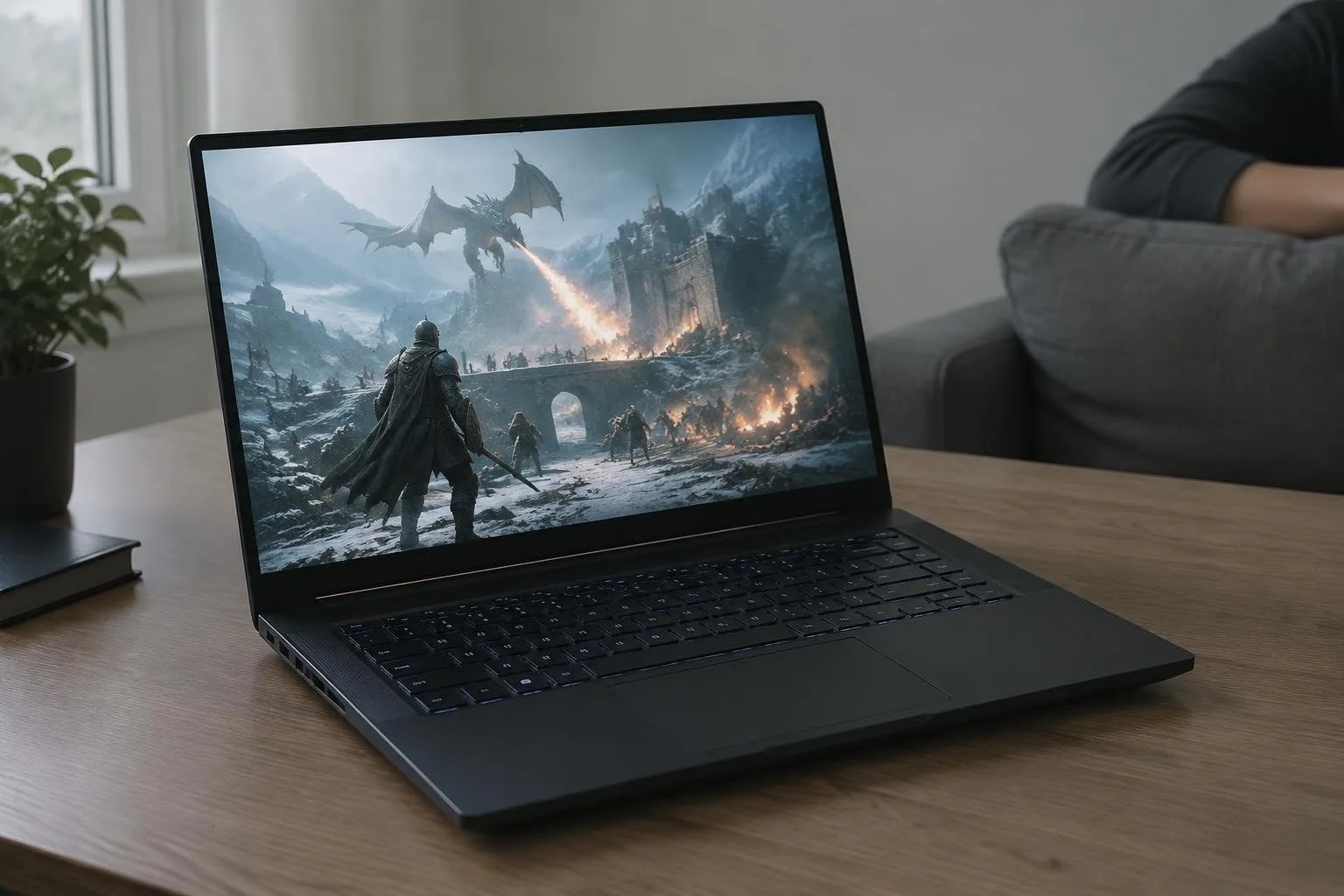
In September 2026 the fifth-generation RTX 5060 emerged as the second-most common graphics card in the Steam Hardware & Software Survey, holding a 4.40 % market share. The laptop-oriented version pairs 8 GB of GDDR7 memory with a base clock around 2,280 MHz and supports the newest DLSS 5 upscaling technology. Retail prices hover at $500 or higher, reflecting the scarcity of new cards.
Sony’s PS5 Pro, launched in late 2024 at $700 and now priced at $1,250, upgrades the console’s custom AMD Zen 2 “Trinity” APU. The GPU portion receives a noticeable bump, but the CPU improvement is only about 10 %. Independent benchmarks show the RTX 5060 (especially the 16 GB Ti variant) can equal or surpass the Pro’s raw horsepower, provided the laptop’s power limit and cooling are adequate. In practice, a well-configured RTX 5060 laptop paired with a mid-range gaming CPU can outperform the PS5 Pro in 4K-60 FPS scenarios, though the console retains an edge in simplicity and price-to-performance for users who prefer a plug-and-play experience.
Practical buying advice for 2026 gamers
When deciding between a console and a PC solution, consider three factors: total system cost, performance ceiling, and future-proofing. If your budget caps at $1,000 and you aim for 4K gaming without extensive tweaking, the PS5 or the newer PS5 Pro remain attractive choices. For those willing to manage a PC build, hunting a used RTX 2070 Super at $280 offers console-level graphics at a fraction of the console’s price, but you must also invest in a compatible CPU, motherboard, and power supply.
On the laptop front, the RTX 5060 clearly outranks the RTX 5050 in core count (3,328 vs. 2,560 CUDA cores) and AI throughput (572 vs. 440 TOPS). The Steam survey shows the 5060 appears in 2.68 % of laptop rigs, while the 5050 lags at 0.48 %. If a laptop stays under $1,000 and offers a power limit of at least 115 W, the 5060 provides a ~30 % advantage in raw compute for a comparable price increase. However, verify the manufacturer’s specifications, as the same GPU name can ship with different wattage settings that dramatically affect performance.
The RTX 2070 Super remains the cheapest PC card that can emulate the base PS5, while the RTX 5060 laptop GPU delivers a clear performance edge over the PS5 Pro when paired with a strong CPU and adequate cooling. Budget-conscious gamers should weigh the total cost of ownership, including secondary-market GPU prices, system memory, and power requirements, before committing to either a console or a custom PC solution.